

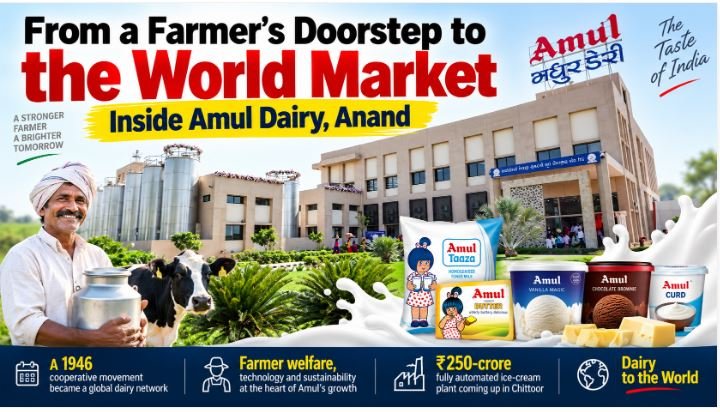
- How a 1946 cooperative movement became a global dairy network
- Farmer welfare, technology and sustainability at the heart of Amul’s growth
- ₹250-crore fully automated ice-cream plant coming up in Chittoor
Anand, Gujarat — Swamy Muddam | Special Report
The name Anand is synonymous with India’s White Revolution. It is here that a farmers’ cooperative movement, which began in 1946, grew into one of India’s most recognisable dairy brands — Amul.
A visit to Amul Dairy in Anand offers a perspective that goes far beyond the products seen on supermarket shelves. Behind every packet of milk, curd, buttermilk, paneer, ice cream or sweet lies an extensive network of dairy farmers, village-level cooperatives, milk collection centres, processing facilities, veterinary services, technology and distribution systems.
What emerges from the visit is a clear picture of Amul not merely as a dairy brand, but as an integrated farmer-owned cooperative system connecting the village to the consumer and, increasingly, to global markets.
Where the White Revolution began
The story of Amul goes back to 1946, when the Kaira District Co-operative Milk Producers’ Union was established. The cooperative model later gained national prominence under the leadership of Dr Verghese Kurien, whose vision transformed India’s dairy sector.
The success of the Anand model eventually became the foundation for Operation Flood, one of the world’s largest dairy development programmes. It connected millions of dairy farmers with organised markets and helped transform India from a milk-deficit nation into the world’s largest milk producer.
The strength of the model lies in its basic principle: the farmer remains at the centre of the value chain.
Instead of simply selling milk to an intermediary, farmers become part of a cooperative system that provides an organised market, technical support and access to services while linking their produce to processing and consumer markets.
The real Amul network is in the villages
One of the most striking aspects of the Amul system is that its real strength is not confined to the large dairy facilities.
It begins in the villages.
Amul’s cooperative network extends across around 18,500 villages in Gujarat, while the organisation is expanding its presence in other parts of the country as well.
The relationship with farmers goes beyond milk procurement. Veterinary services, vaccination programmes, cattle feed, milking machines, cattle mats and farmer-awareness initiatives form part of the support system.
This makes the Amul model considerably broader than a conventional milk procurement operation.
The farmer is connected to the system before the milk reaches the collection point and remains at the centre of the process through production, procurement and payments.
From milk to more than 250 products
Amul has evolved from a milk cooperative into a diversified food and dairy enterprise.
Today, the Amul portfolio includes more than 250 products, covering milk, curd, buttermilk, paneer, ice cream, sweets and several other dairy and food categories.
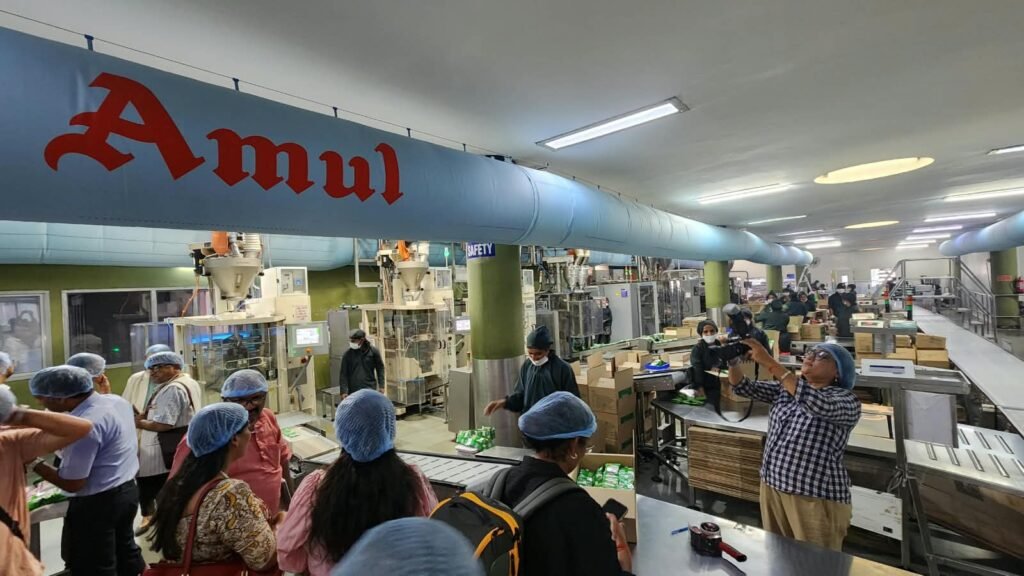
The journey of a product begins much earlier than the processing plant. It starts with the farmer and the animal, followed by milk collection, quality checks, chilling, processing, packaging and distribution.
This integrated structure is one of the reasons the Amul cooperative model has remained relevant for decades.
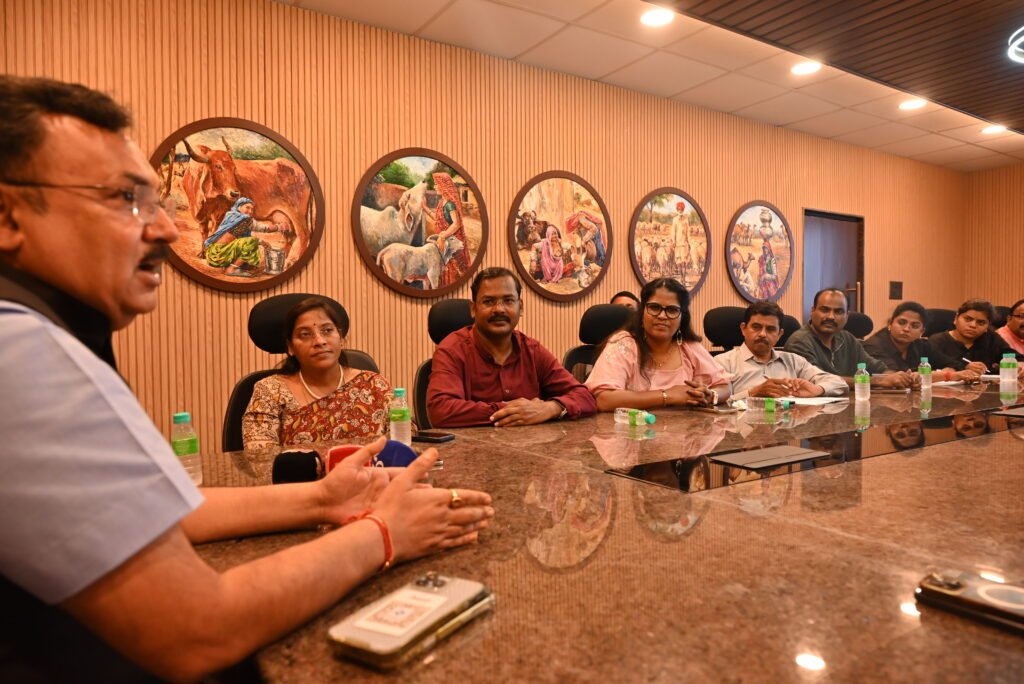
Dr. Amit Vyas, Managing Director of Amul Dairy, briefing a team of Telangana journalists—led by PIB IIS officer Varganti Gayatri—about the organization.
Technology enters the dairy ecosystem
The traditional cooperative model at Amul is increasingly being combined with digital technology.
The organisation has introduced digital systems for tracking animal health and maintaining information related to livestock. Data relating to calves, including births and health conditions, is being integrated into digital systems.
Technology is also being used within the organisation to reduce paperwork and improve transparency.
The digital transformation extends to procurement orders, payments and decision-making processes. According to the management, the organisation has moved towards a paperless system, with historical records and institutional decisions being digitally preserved.
The objective is not simply faster administration. Digital systems are also intended to improve transparency and accountability across a large cooperative network.
From cattle waste to clean energy
Another interesting dimension of Amul’s operations is its focus on the circular economy.
Cattle dung, which is traditionally treated as agricultural waste, is being viewed as a potential source of energy and agricultural inputs.
As part of an India-Japan initiative, Amul is working towards the establishment of 1,000 biogas plants. Four plants have already been completed in Banaskantha, while a modern biogas facility is being developed at Ood, near Anand.
The proposed facility is expected to collect around 75 to 100 tonnes of cattle dung a day, convert it into gas and utilise it as Bio-CNG. The residual material can then be processed into Bio-NPK liquid fertiliser.
Plans also include gas dispensing stations and soil-testing centres within a radius of about 50 kilometres.
The broader idea is simple but significant — turning livestock waste into energy and fertiliser while creating additional value for the rural economy.
Solar power and sustainable practices
Sustainability is another area receiving attention.
According to Amul, around 1,250 cooperative societies in Kheda district are operating on solar power.
Rainwater conservation and other environmental initiatives are also being implemented.
These efforts indicate how the cooperative network is gradually being connected with renewable energy, resource conservation and technology rather than remaining limited to traditional dairy operations.
Amul expands its footprint in South India
The organisation’s expansion is not restricted to Gujarat or northern and eastern India.
In South India, Chittoor in Andhra Pradesh has emerged as an important location for Amul’s expansion.
The company has already invested more than ₹200 crore in its Chittoor operations, where products including liquid milk, buttermilk, curd, paneer and sweets are being produced.
Now, another major investment is planned.
A ₹250-crore, highly advanced and fully automated ice-cream plant is being developed in Chittoor. Once operational, the facility is expected to strengthen Amul’s manufacturing and distribution capabilities in southern India.
The company is also considering future investments in cattle-feed facilities as part of its broader farmer-support ecosystem.
What Amul Dairy MD Dr Amit Vyas told us
During the visit, Amul Dairy Managing Director Dr Amit Vyas explained the organisation’s growth, expansion strategy and future vision.
He said Amul had now evolved into a “Dairy to the World”, moving beyond its traditional identity as an Indian dairy cooperative.
According to Dr Vyas, the cooperative model faced doubts in its early years, with many questioning whether such a system could succeed. The continued support of farmers, consumers and the government, he said, had helped the cooperative become stronger.
He attributed much of Amul’s public acceptance to consumer trust and said that this connection had made Amul synonymous with “The Taste of India.”
Dr Vyas emphasised that farmer welfare remains the central objective of the organisation.
He said Amul’s role was not merely to provide consumers with quality products but also to ensure that farmers receive the best possible price for their produce.
The organisation, he said, had expanded its farmer-focused activities from Jammu and Kashmir to the eastern parts of the country. New plants are being developed in Assam and Bihar, while land has been allotted by the Bihar government. A major plant is also being established in West Bengal, for which the foundation stone has been laid.
On southern India, Dr Vyas highlighted the investment in Chittoor, saying more than ₹200 crore had already been invested there and another ₹250 crore was being spent on the fully automated ice-cream plant.
He also spoke about Amul’s digital transformation. After taking charge as Managing Director in 2018, he said the dairy had been moved towards 100 per cent digitalisation and a paperless system. Records dating back to 1946, including board-meeting decisions, have been digitally preserved, while procurement orders and bank payments are processed through online systems.
Dr Vyas said the organisation had recorded significant growth during the past six to seven years, with turnover rising from around ₹16,500 crore to ₹17,000 crore, according to the figures he shared.
Looking ahead, he said India currently accounts for around 24 per cent of global milk production and that the aim is to increase the country’s share to 42 per cent by 2047, with India emerging as the world’s largest exporter of dairy products.
“Amul belongs to the farmers,” Dr Vyas stressed, reiterating that the cooperative’s objective is to provide farmers with the best possible returns while making quality products available to consumers at reasonable prices.
More than a brand — a cooperative movement
A visit to Amul Dairy makes one fact particularly clear: Amul is much more than the brand printed on a milk packet.
Behind the familiar logo is a network that begins with a farmer in a village.
The farmer is supported by a cooperative society. The milk moves through collection and quality-control systems before reaching modern processing facilities. From there, it becomes one of hundreds of products that eventually reach consumers across India and international markets.
The model brings together farmer ownership, assured market access, technology, processing, marketing and consumer demand within a single ecosystem.
That is perhaps the most important lesson from Anand.
The success of Amul did not come from building a powerful brand first and then finding farmers to supply it. It evolved in the opposite direction — strengthening farmers and their cooperative institutions first, and building the brand around that foundation.
From the farmer’s doorstep in a Gujarat village to markets across India and the world, Amul represents a remarkable journey of cooperative enterprise.
The packet may carry the Amul name. But at the heart of the story is the farmer.