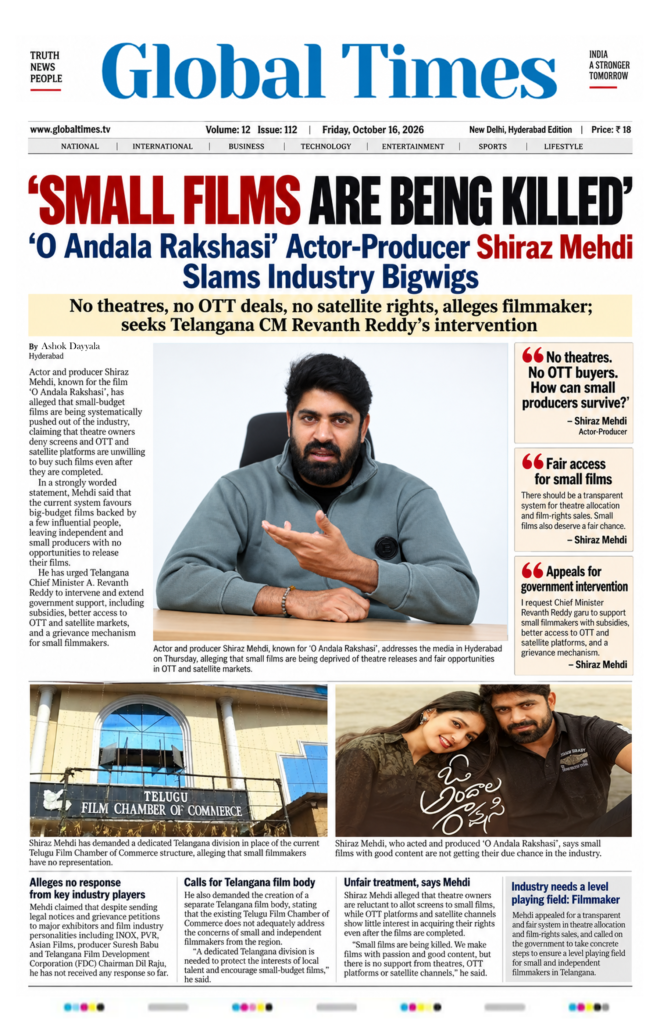


▪️ No theatres, no OTT deals, no satellite rights: Small producers left struggling to recover investments
▪️ Serious allegations against the Film Chamber, PVR, INOX and Asian Films
▪️ Shiraz Mehdi seeks Telangana CM Revanth Reddy’s intervention to protect small filmmakers
▪️ Demands a separate Telangana division in place of the Telugu Film Chamber
▪️ Claims legal notices and grievance petitions have gone unanswered
Hyderabad: Making a film is one challenge, but releasing it in theatres and recovering the investment is proving to be an even bigger struggle for small-budget filmmakers. Despite investing substantial amounts of money and completing their projects, many small producers reportedly face difficulties securing theatres and selling their films’ OTT and satellite rights.
Actor and producer Shiraz Mehdi, known for his film O Andala Rakshasi, has launched a strong attack on what he describes as discriminatory practices within the Telugu film industry. He has alleged that small films are being denied theatrical opportunities and that their commercial prospects are being systematically undermined. His remarks have brought renewed attention to the challenges faced by independent filmmakers and small-budget producers.
Mehdi expressed anguish over the lack of support for producers who borrow money, invest their savings and complete films with the hope of reaching audiences and recovering their investments.
Is Making a Film Becoming a Mistake?
Shiraz Mehdi said that while producers invest considerable amounts in filmmaking, their real struggle often begins after production is completed. Securing a release, finding theatre slots and identifying buyers for distribution rights have become major obstacles for small films, he alleged.
He criticised the attitude of the Film Chamber, claiming that its response to struggling producers appeared to be along the lines of, “Why did you make a film in the first place?” He alleged that the organisation was displaying an indifferent attitude towards films made by producers outside its immediate circle.
According to Mehdi, if producers receive little encouragement during production and encounter further hurdles at the time of release, they are left wondering where to turn for support.
He also demanded the establishment of a separate Telangana division in place of the existing Telugu Film Chamber structure, arguing that the problems of Telangana-based filmmakers and small producers require focused attention.
No Theatres, No OTT Buyers: How Can Producers Survive?
Mehdi alleged that small films are struggling to secure theatrical releases and are also finding it difficult to sell their digital streaming and satellite rights. These challenges, he said, are pushing producers into severe financial distress.
He questioned how a producer could survive if all the avenues for recovering the money invested in a film were effectively closed.
“Why do big-budget films get opportunities while small films struggle to find screens?” was the central question raised by Mehdi in highlighting the disparity he perceives in the industry.
He warned that unless these issues are addressed, aspiring producers, directors and actors could find it increasingly difficult to establish themselves in the Telugu film industry. Such barriers, he argued, could discourage new talent and reduce opportunities for independent filmmaking.
What Is the Film Chamber Doing for Small Producers?
Mehdi criticised the Film Chamber for what he described as its failure to take responsibility for the commercial difficulties faced by small filmmakers.
He alleged that industry organisations sometimes intervene when disputes arise between actors, directors and producers, but appear less willing to address issues concerning film releases, theatrical access and the sale of distribution rights.
He called for a transparent and structured system through which films could access commercial opportunities across different markets.
According to Mehdi, a fair mechanism should facilitate the sale of film rights in Telugu and other Indian-language markets, including Tamil, Kannada, Malayalam and Hindi, as well as overseas territories.
He stressed that small films should have access to legitimate business opportunities rather than being left to struggle without institutional support.
“Do Only Farmers’ Lives Matter? What About Film Workers?”
Making an emotional appeal, Mehdi pointed out that small films represent more than the financial investment of a single producer. The livelihoods of numerous people, including directors, actors, technicians and other film workers, are connected to each project.
He questioned why society responds to the suffering of farmers who face severe losses, while the financial distress of producers, directors and actors who borrow money and risk their livelihoods to make films often receives limited attention.
He argued that the hardships of the film industry’s smaller stakeholders should also be viewed from a humanitarian perspective and that their financial struggles should not be dismissed lightly.
Mehdi emphasised that behind every small film are the hopes, livelihoods and futures of several families. When a film fails to secure a release or generate revenue, the consequences can extend far beyond the producer.
Shiraz Mehdi Appeals to CM Revanth Reddy
Mehdi urged Telangana Chief Minister A. Revanth Reddy and the state government to intervene immediately and introduce measures to support small-budget films.
Among his key demands were:
Subsidies for small-budget films to help ease the financial burden on producers.
Transparency in theatre allocation to ensure that small films receive fair opportunities for theatrical releases.
Better access to OTT platforms so that producers can sell their digital streaming rights.
Improved opportunities for satellite rights to create additional revenue streams.
A dedicated mechanism to address small filmmakers’ grievances and resolve disputes concerning releases and commercial opportunities.
He expressed the view that government intervention could help create a more equitable environment for small filmmakers.
Referring to the situation in Andhra Pradesh during the tenure of former Chief Minister Y. S. Jagan Mohan Reddy, Mehdi called on the Telangana government to pay special attention to the challenges faced by small producers and take appropriate steps to protect their interests.
Legal Notices Sent, but No Response, Claims Mehdi
Shiraz Mehdi further stated that he had sent legal notices and grievance petitions to several industry stakeholders, including INOX, PVR, Asian Films, producer Suresh Babu and Telangana Film Development Corporation (FDC) Chairman Dil Raju.
However, he claimed that he had not received responses to these communications.
Mehdi urged the concerned organisations and individuals to respond to the issues he had raised and address the difficulties faced by small-film producers.
His allegations have once again highlighted a broader concern within the film industry: whether smaller productions have a fair opportunity to reach audiences and recover their investments in an increasingly competitive theatrical and digital market.
The key question now is whether the industry’s representative bodies and the Telangana government will respond to the concerns raised by small filmmakers and work towards a more transparent and accessible system.