

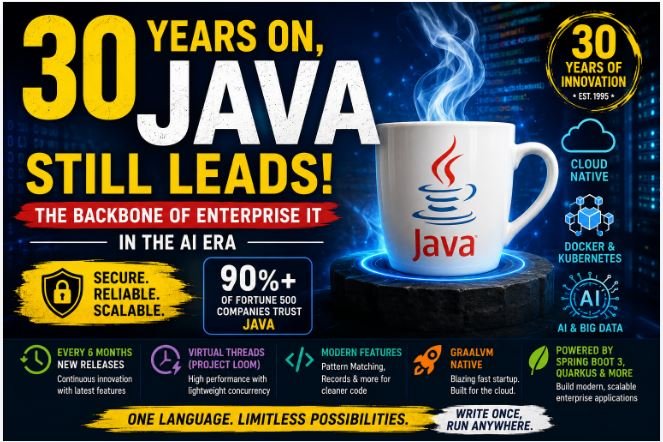
Why Java Continues to Be the Backbone of Enterprise IT in the AI Era
In the fast-changing world of technology, programming languages rise and fall with remarkable speed. Every few years, a new language or framework captures the industry’s attention, while many older technologies gradually fade away. Yet, one programming language has consistently defied this trend—Java.
Launched in 1995, Java has completed an extraordinary journey of 30 years. Despite the rapid emergence of Artificial Intelligence (AI), cloud computing, and next-generation development platforms, Java remains one of the world’s most trusted and widely used programming languages. Its unmatched reliability, security, scalability, and continuous evolution have enabled it to retain its leadership in enterprise software development.
Today, Java is not merely surviving—it is thriving.
The Language Behind the World’s Largest Enterprises
From global banks and insurance companies to e-commerce giants, telecommunications firms, and government digital services, Java continues to power mission-critical systems across industries.
More than 90% of Fortune 500 companies rely on Java for their core backend applications, enterprise platforms, and secure transaction systems. The reason is simple: organizations need technology that is stable, secure, scalable, and capable of supporting millions of users without compromising performance.
While newer programming languages continue to gain popularity, replacing decades of enterprise software built on Java would require enormous investments and carry significant operational risks. For large organizations, migrating billions of lines of Java code is neither economical nor practical.
Legacy Strength with Modern Capabilities
One of Java’s greatest advantages is its exceptional backward compatibility. Applications written years—or even decades—ago can often run seamlessly on modern Java Virtual Machines (JVMs) with minimal modifications.
This long-term stability protects organizations from expensive redevelopment projects while ensuring continuous business operations.
Java is also renowned for its robust security architecture. Features such as automatic memory management through Garbage Collection, strong type checking, and the absence of direct memory pointers significantly reduce vulnerabilities and improve software reliability. These qualities have made Java the preferred choice for industries where security and stability are non-negotiable.
Reinventing Itself Every Six Months
Many developers still associate Java with Java 8, but the language has evolved dramatically over the past decade.
Oracle’s six-month release cycle has transformed Java into one of the industry’s fastest-evolving enterprise platforms. Recent releases, including Java 25 and Java 26, introduce features that dramatically improve performance, developer productivity, and cloud readiness.
Virtual Threads (Project Loom) enable applications to handle thousands of concurrent tasks using significantly less memory, making high-performance applications more efficient than ever.
Modern language enhancements such as Pattern Matching and Records reduce boilerplate code, making software easier to write, understand, and maintain.
Meanwhile, GraalVM Native Compilation enables applications to start in milliseconds rather than seconds, a critical advantage for cloud-native deployments and serverless architectures.
Built for the Cloud Era
As enterprises increasingly migrate to cloud environments, Java has successfully adapted to the demands of modern software architecture.
Frameworks like Spring Boot 3, Quarkus, and Micronaut are specifically optimized for Docker containers, Kubernetes orchestration, and microservices-based applications. They enable developers to build lightweight, scalable, and highly efficient cloud-native solutions.
Java’s extensive ecosystem further strengthens its position. Development tools such as IntelliJ IDEA and Eclipse, along with powerful technologies like Hibernate, Apache Kafka, and Maven, continue to enhance developer productivity and simplify enterprise application development.
Java’s Growing Role in AI and Big Data
Python may dominate AI research and rapid prototyping, but Java remains indispensable for large-scale production systems.
Many of the world’s leading Big Data platforms—including Apache Hadoop and Apache Spark—are deeply rooted in the Java ecosystem.
The emergence of frameworks such as Spring AI and LangChain4j has further expanded Java’s role in Artificial Intelligence. These technologies enable enterprise applications to integrate seamlessly with modern AI models, including large language models (LLMs), while maintaining enterprise-grade security, scalability, and reliability.
Although AI can generate code, designing secure architectures, managing dependency injection, ensuring maintainability, and building enterprise-grade software still require the strong engineering foundations that Java provides.
“Write Once, Run Anywhere” Still Matters
Perhaps no phrase defines Java better than its iconic principle:
“Write Once, Run Anywhere.”
Applications developed in Java can run across Windows, Linux, macOS, and virtually every major cloud platform—including AWS, Microsoft Azure, and Google Cloud—through the Java Virtual Machine (JVM).
Even though Kotlin has become popular for Android development, Java continues to serve as the technological foundation of the Android ecosystem, with millions of applications and libraries still relying on it.
Looking Ahead
Thirty years after its introduction, Java remains one of the most influential programming languages in the world. Its remarkable ability to evolve with emerging technologies while preserving backward compatibility has ensured its relevance in an industry defined by constant change.
As Artificial Intelligence, cloud computing, cybersecurity, and large-scale distributed systems continue to reshape the digital economy, Java is expected to remain at the heart of enterprise software development.
Its combination of reliability, performance, security, scalability, and continuous innovation explains why Java continues to power some of the world’s most critical digital infrastructure—and why, even after three decades, its popularity shows no signs of slowing down.

— G. Gayathri
B.Tech, BBA
LinkedIn Influencer