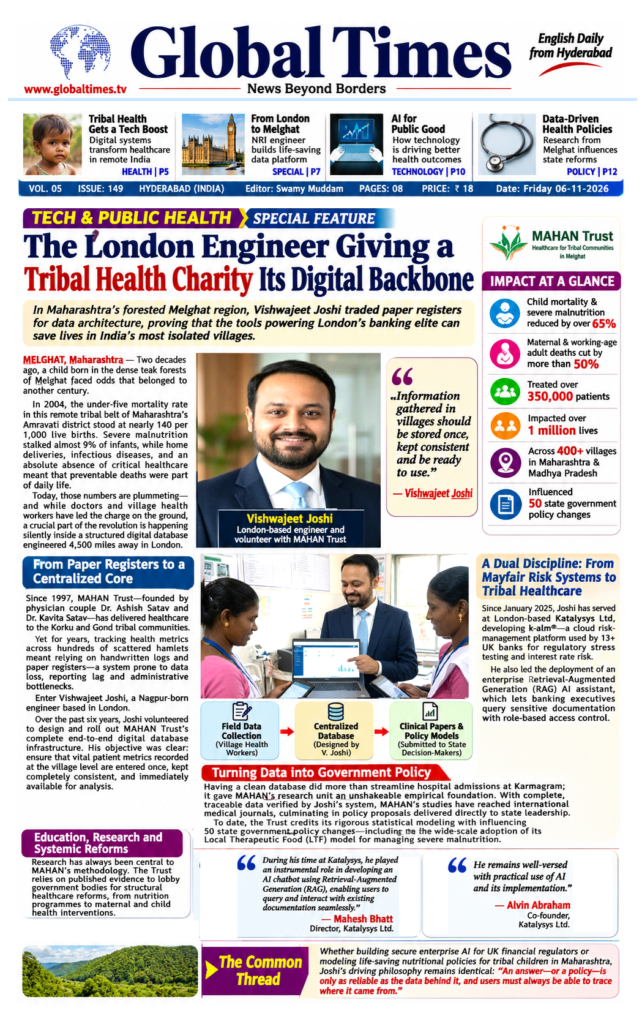

- In Maharashtra’s forested Melghat region, Vishwajeet Joshi traded paper registers for data architecture, proving that the tools powering London’s banking elite can save lives in India’s most isolated villages.
- MELGHAT, Maharashtra — Two decades ago, a child born in the dense teak forests of Melghat faced odds that belonged to another century.
In 2004, the under-five mortality rate in this remote tribal belt of Maharashtra’s Amravati district stood at nearly 140 per 1,000 live births. Severe malnutrition stalked almost 9% of infants, while home deliveries, infectious diseases, and an absolute absence of critical healthcare meant that preventable deaths were part of daily life.
Today, those numbers are plummeting—and while doctors and village health workers have led the charge on the ground, a crucial part of the revolution is happening silently inside a structured digital database engineered 4,500 miles away in London.
From Paper Registers to a Centralized Core
Since 1997, MAHAN Trust—founded by physician couple Dr. Ashish Satav and Dr. Kavita Satav—has delivered healthcare to the Korku and Gond tribal communities. Through grassroots home-based care and its central hospital at Karmagram, the Trust has:
Reduced child mortality and severe malnutrition by over 65%.
Cut maternal and working-age adult deaths by more than 50%.
Treated over 350,000 patients and impacted over 1 million lives across more than 400 villages in Maharashtra and neighbouring Madhya Pradesh.
Yet for years, tracking health metrics across hundreds of scattered hamlets meant relying on handwritten logs and paper registers—a system prone to data loss, reporting lag, and administrative bottleneck.
Enter Vishwajeet Joshi, a Nagpur-born engineer based in London.
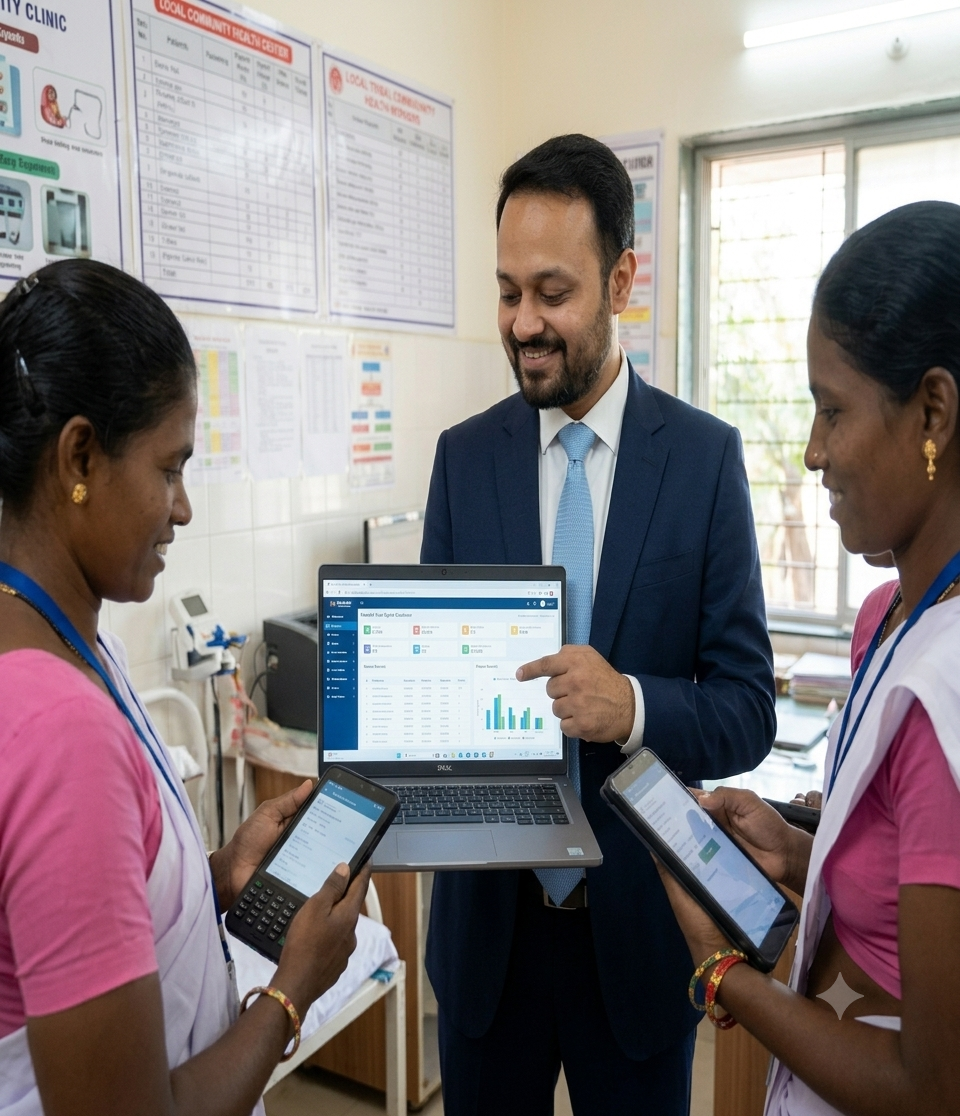
Over the past six years, Joshi volunteered to design and roll out MAHAN Trust’s complete end-to-end digital database infrastructure. His objective was clear: ensure that vital patient metrics recorded at the village level are entered once, kept completely consistent, and immediately available for analysis.
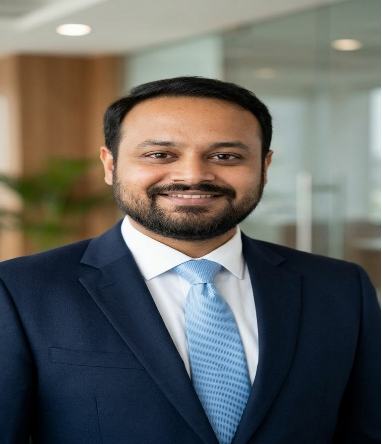
“Information gathered in villages should be stored once, kept consistent and be ready to use.”
— Vishwajeet Joshi
Turning Data into Government PolicyHaving a clean database did more than streamline hospital admissions at Karmagram; it gave MAHAN’s research unit an unshakeable empirical foundation.Research has always been central to MAHAN’s methodology. The Trust relies on published evidence to lobby government bodies for structural healthcare reforms. With complete, traceable data verified by Joshi’s system, MAHAN’s studies have reached international medical journals, culminating in policy proposals delivered directly to state leadership.To date, the Trust credits its rigorous statistical modeling with influencing 50 state government policy changes—including the wide-scale adoption of its Local Therapeutic Food (LTF) model for managing severe malnutrition. A Dual Discipline: From Mayfair Risk Systems to Tribal HealthcareJoshi’s work for MAHAN mirrors the exact rigor he applies in his high-stakes day job.Since January 2025, Joshi has served at London-based Katalysys Ltd, developing k-alm®—a specialized cloud risk-management platform deployed across more than 13 UK banks for regulatory stress testing, funds transfer pricing, and interest rate risk supervision under the UK’s Prudential Regulation Authority.At Katalysys, Joshi led the deployment of an enterprise Retrieval-Augmented Generation (RAG) AI assistant. The AI enables banking executives to query sensitive internal documentation while enforcing role-based access control—delivering granular legal code to compliance officers while supplying high-level impact summaries to Chief Financial Officers.”During his time at Katalysys, he played an instrumental role in developing an AI chatbot using Retrieval-Augmented Generation (RAG), enabling users to query and interact with existing documentation seamlessly,” noted Mahesh Bhatt, Director at Katalysys. Co-founder Alvin Abraham added that Joshi remains “well-versed with practical use of AI and its implementation”—contributing to software suites generating nearly £1 million annually in license fees.
The Common Thread
Whether building secure enterprise AI for UK financial regulators or modeling life-saving nutritional policies for tribal children in Maharashtra, Joshi’s driving philosophy remains identical:
An answer—or a policy—is only as reliable as the data behind it, and users must always be able to trace where it came from.